
Jiawei Liu1, 2, Zijun Wu1*, Bradley A Weymer3, Qianqian Wang4, Qiyue Gu3, Yuanqing Chen1, Zhonglin Ma1, Yiqing Wang1, Bulderxen Huate1, Guanlin Li1, Jiangtao Li1, Nicole Kowalski2, 5, Michael Ernst Böttcher2, 6, 7
1 State Key Laboratory of Marine Geology, Tongji University, Shanghai, 200092, China
2 Geochemistry & Isotope Biogeochemistry Group, Department of Marine Geosciences, Leibniz Institute for Baltic Sea Research (IOW), D-18119 Warnemünde, Germany
3 School of Oceanography, Shanghai Jiao Tong University, 1954 Huashan Road, Shanghai 200030, China
4 State Key Laboratory of Estuarine and Coastal Research, East China Normal University, Shanghai, 200241, China
5 Present address: LMS Agrarberatung GmbH, LUFA Rostock, D-18059 Rostock, Germany
6 Marine Geochemistry, University of Greifswald, D-17489 Greifswald, Germany
7 Interdisciplinary Faculty, University of Rostock, D-18059 Rostock, Germany
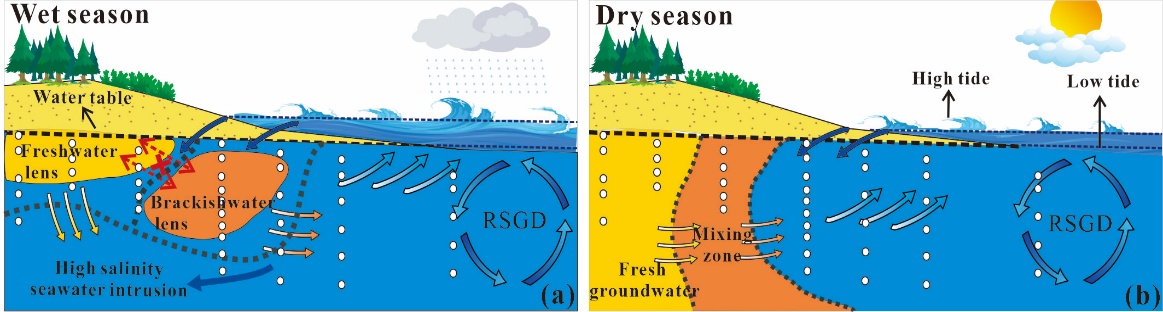
Abstract: Submarine groundwater discharge (SGD) is an important pathway for dissolved carbon delivery to the coastal ocean and a potential driver of coastal acidification; however, the controls on the sources and transformations of SGD-derived carbon remain poorly constrained for sandy beach aquifers under contrasting seasonal conditions. Here, we integrated geochemical, geophysical, and microbial approaches to investigate a permeable subterranean estuary (STE) on the northern coast of the subtropical Beibu Gulf, South China Sea. The contrasting wet and dry seasons provided a natural setting to examine coupled hydrological–biogeochemical processes affecting the dissolved carbonate system. A freshwater lens was observed during the wet season, when precipitation was higher, whereas it was largely absent from the supratidal beach zone during the dry season. This seasonal contrast was associated with changes in salinity distribution, end-member mixing, and carbonate chemistry within the STE. Dissolved inorganic carbon (DIC), total alkalinity (TA), and Ca2+ exhibited non-conservative behavior across salinity zones. Geochemical and microbial evidence suggested sulfate reduction during the wet season, whereas aerobic respiration appeared to be a more important pathway for organic matter degradation during the dry season. CO2 outgassing and carbonate dissolution–precipitation likely further modified the carbonate system in both seasons. SGD-derived DIC fluxes averaged (4.0 ± 0.5) × 105 mol d−1 in the wet season and (5.0 ± 0.4) × 105 mol d−1 in the dry season, comparable to DIC inputs from the adjacent Fengjia River. Most groundwater TA/DIC ratios were below 1 and lower than those of offshore seawater in the Beibu Gulf, consistent with SGD contributing to coastal acidification. The acidifying potential of SGD appeared higher during the dry season, possibly reflecting a larger contribution of inland-derived freshwater SGD and associated shifts in biogeochemical pathways. The estimated [TA–DIC] flux indicates that SGD may have had a stronger acidifying influence than that of the Fengjia River during the dry season. Overall, these findings highlight the seasonal evolution of transient freshwater lenses as a factor that can modulate carbon cycling, export, and acidification potential in sandy beach aquifers, and underscore the need to integrate SGD and its biogeochemical impacts into regional carbon budgets and carbonate chemistry assessments for unvegetated sandy coastal systems worldwide.
Full Article:https://doi.org/10.1016/j.gca.2026.11.021