

On the morning of October 22, 2025, at the invitation of Professor Cheng Yifang, Professor Yehuda Ben-Zion from the University of Southern California (USC) visited the State Key Laboratory of Marine Geology and delivered the 60th Blue Ocean Forum lecture, titled “Theoretical and Observational Results on Damage Related Radiation,” in the first-floor lecture hall of the Ocean Building. The lecture examined the mechanisms and observational evidence of radiation generated by rock damage during earthquake rupture processes, offering both theoretical depth and methodological innovation.
Professor Ben-Zion is the Director of the Southern California Earthquake Center (SCEC) and Professor of Earth Sciences at USC. He is a leading expert in earthquake and fault physics, with over 300 scientific papers and several academic books, and has been invited to deliver numerous keynote lectures worldwide. His research has had a profound impact on the development of earthquake source theory and has been widely cited. Professor Ben-Zion is a Fellow of the American Geophysical Union (AGU) and has received multiple international honors, including the Beno Gutenberg Medal from the European Geosciences Union (EGU), the Humboldt Research Award in Geophysics, and the Mercator Fellowship from the German Research Foundation (DFG). He has also served as an editor for the Journal of Geophysical Research and holds leadership roles in several major international scientific organizations and journals.
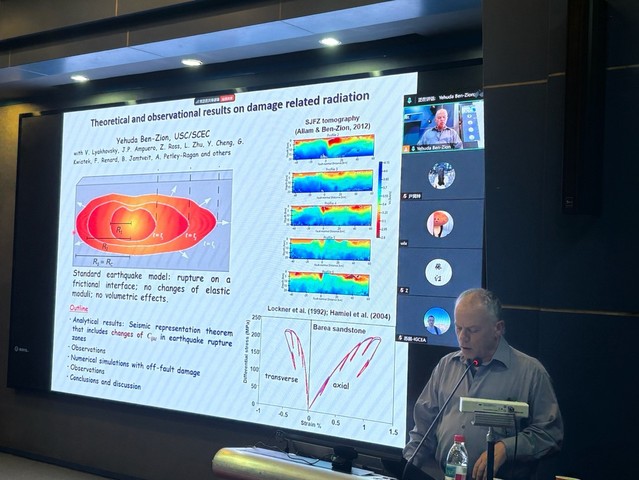
In his lecture, Professor Ben-Zion pointed out that extensive laboratory and field observations demonstrate that real earthquakes are accompanied by substantial rock damage, the development of microcracks, and reductions in elastic moduli—resulting in localized volumetric expansion or contraction. These phenomena challenge the assumptions of traditional earthquake source models, which often idealize ruptures as a purely shear process occurring along a frictional interface with constant elastic properties and no volumetric change. By allowing elastic moduli to vary dynamically in the representation theorem for seismic sources, Professor Ben-Zion introduced the concept of a “damage-related radiation” source term. This term accounts for additional isotropic radiation that can significantly enhance the high-frequency P-wave energy radiated from the source.
He further presented experimental and observational evidence supporting this framework. Data from deep-mine microseismic events in South Africa, earthquakes in the San Jacinto Fault Zone in California, and the 2019 Ridgecrest earthquake sequence all revealed a measurable isotropic component (approximately 1%–15%) in source inversions, consistent with the predictions of the damage-related radiation model. Professor Ben-Zion concluded that this newly recognized source term is a key element in understanding the true physical processes of earthquake rupture. He underscored that future progress in this field will rely on the integration of high-resolution near-fault observations, laboratory experiments, and multi-scale theoretical modeling, ultimately enabling more comprehensive descriptions of earthquake sources and fault dynamics.
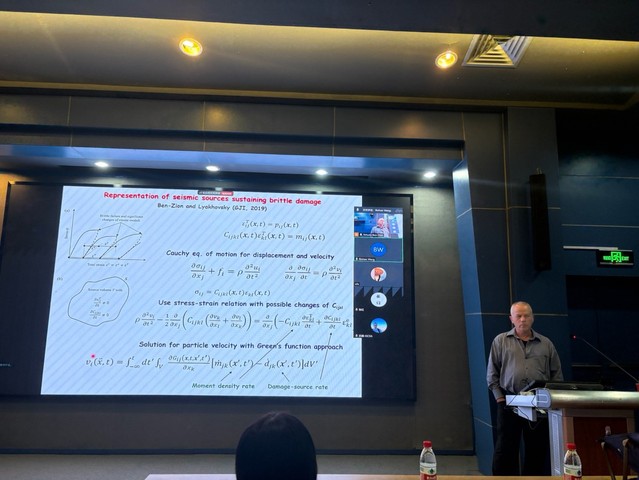
The lecture attracted both in-person and nearly seventy online audiences from within and outside Tongji University. Attendees engaged in lively discussions on topics such as how damage-related radiation affects high-frequency ground motions and whether isotropic source components can shed light on deep-fault energy release mechanisms. The event highlighted cutting-edge advances in rupture physics, damage evolution, and high-frequency radiation within the international seismological community, and provide new perspectives and inspiration for ongoing research in earthquake source physics and fault dynamics at our institute.
Looking ahead, the laboratory will continue to strengthen collaborations with leading international research teams, focusing on key scientific questions such as earthquake energy partitioning and fault structural evolution. By deepening our understanding of the dynamic processes governing earthquake initiation and rupture, we aim to provide a stronger scientific foundation for earthquake forecasting and seismic hazard mitigation.
Written by: Xinran Li