
Chongjin Zhao, Luolei Zhang, Huang Zuwei, Peng Yu
State Key Laboratory of Marine Geology, Tongji University, 1239 Siping Road, Shanghai 200092, China
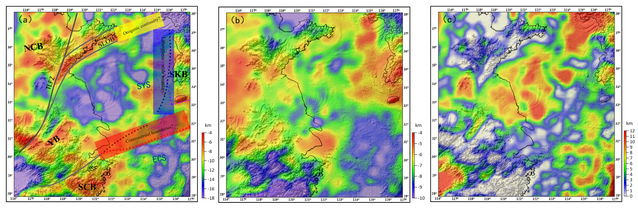
Abstract: The Lower Yangtze region lies between the North China Craton and Cathaysia Block; yet, the offshore continuity of major sutures and the role of inherited basement faults remain debated. We integrate 3-D inversions of regional magnetic and gravity data for crustal framework imaging without reduction-to-the-pole. In particular, we perform magnetic inversion directly on the total magnetic intensity (TMI) under oblique field geometry, coupled with a sharp-boundary gravity inversion to the TMI-derived magnetic basement. Petrophysical ranges for densities and susceptibilities provide the sole priors, and edges are mapped with a tilt–hyperbolic–vertical–horizontal (THVH) operator. Misfits reach observational noise levels, and the recovered volumes resolve long- to intermediate-wavelength structures. Magnetization is concentrated beneath the East China Sea shelf and southern South Yellow Sea, while 10–20 km density slices delineate alternating uplift–depression couplets. Three surfaces (i.e., the Magnetic-basement top, Paleozoic-basement proxy depth, and Proterozoic residual-thickness proxy) define coherent gradients that, together with THVH ridges, map a consistent fault framework. We infer (i) an eastward offshore continuation of the Jiangshan–Shaoxing Fault that bends northeast and is truncated near the southwestern margin of Jeju Island; (ii) a lithosphere-scale Yangtze–North China boundary coincident with the Korea–West Fault; and (iii) four inherited NE–EW faults that segment the region into alternating uplifts and depressions. The architecture supports Late Cretaceous back-arc extension and selective reactivation of Precambrian discontinuities.
Full article: https://doi.org/10.1016/j.tecto.2025.231001