
Ke Li1, Jun Tian1, Ning Zhao2, Jianghui Du3, Zhonghui Liu4, Jinlong Du1, and Enqing Huang1
1 State Key Laboratory of Marine Geology, Tongji University, Shanghai 200092, China
2 State Key Laboratory of Estuarine and Coastal Research and School of Marine Sciences, East China Normal University, Shanghai 200241, China
3 Key Laboratory of Orogenic Belts and Crustal Evolution, MOE; School of Earth and Space Sciences, Peking University, Beijing 100871, China
4 Department of Earth Sciences, The University of Hong Kong, Hong Kong, China
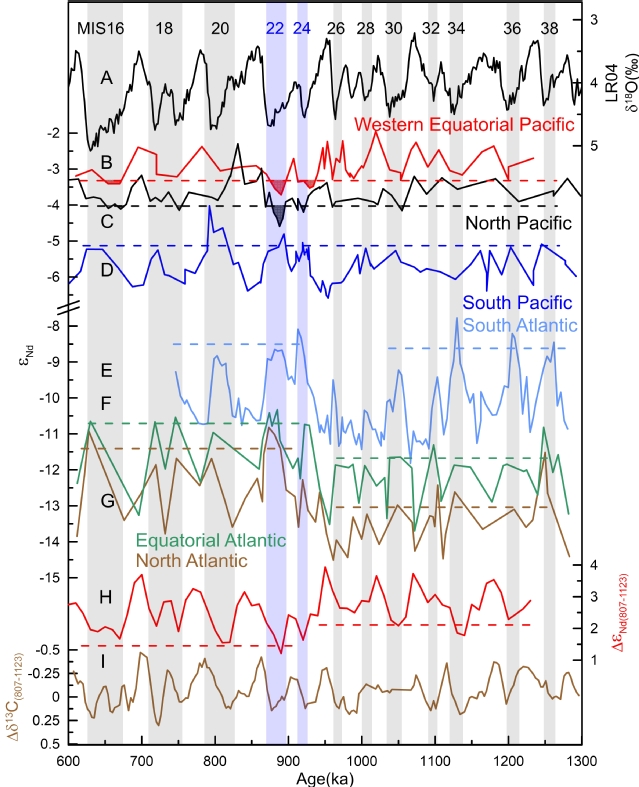
Abstract: The Mid-Pleistocene Transition (MPT, 600-1300 ka) marks the shift of the dominant ice age cycle from 41-kyr to 100-kyr in the late Pleistocene. While the Atlantic Ocean circulation changes have been found to be closely linked with the MPT, the Pacific's role remains poorly constrained. Here we present fish teeth neodymium isotope (εNd) records from three sites along the Pacific Deep Western Boundary Current (DWBC) to capture the Pacific deep ocean circulation changes on Glacial-Interglacial (G-IG) timescale during the MPT. We found reduced deep water εNd gradient (ΔεNd) between north and south Pacific during glacial periods. After constraining non-conservative influences on εNd, we infer that enhanced northward expansion of Southern Component Water (SCW) and/or shoaling of the Pacific Deep Water (PDW)-Lower Circumpolar Deep Water (LCDW) interface best explain the observed patterns. While the G-IG variability of the ΔεNd is largely consistent throughout the MPT, indicating a generally stable rhythm of Pacific deep overturning circulation, the pronounced εNd values of the three Pacific sites during Marine Isotope Stage (MIS) 22 suggest a transient circulation anomaly. The rigorous Pacific deep ocean circulation enhanced the ocean carbon storage through surface disequilibrium during glacials. Our results indicate that ocean circulation has played an important role in shaping the late Pleistocene ice ages through interaction with carbon cycle.
Full article:https://doi.org/10.1016/j.gloplacha.2025.105229