
Lei Su1, Andreas P. Teske2, Ian P. G. Marshall3, Zichao Zeng4, Yinzhao Wang4, Kurt O. Konhauser5*, Yuhao Li5, Shengwei Hou6, Jiangtao Li1*
1 State Key Laboratory of Marine Geology, Tongji University, Shanghai, China
2 Department of Earth, Marine and environmental Sciences, University of North Carolina at Chapel Hill, Chapel Hill, NC 27599, USA
3 Center for Electromicrobiology (CEM), Section for Microbiology, Department of Biology, Aarhus University, Aarhus C, Denmark
4 State Key Laboratory of Microbial Metabolism, School of Life Sciences and Biotechnology, Shanghai Jiao Tong University, Shanghai 200240, China
5 Department of Earth & Atmospheric Sciences, University of Alberta, Edmonton, Alberta T6G 2E3, Canada
6 Department of Ocean Science and Engineering, Southern University of Science and Technology, Shenzhen, China
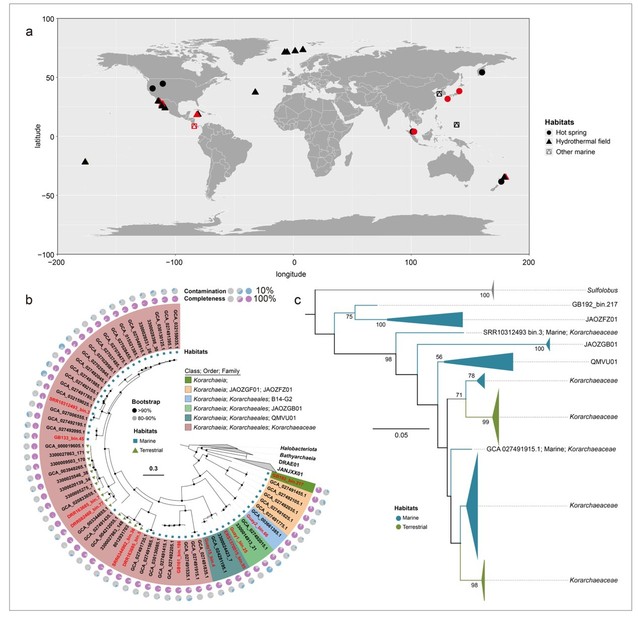
Abstract: Korarchaeota, an ancient lineage of archaea, has long been overlooked in discussions of archaeal and eukaryotic evolution. Their physiology and evolutionary history have remained enigmatic due to their rarity in natural environments. Here, we assembled 101 Korarchaeota genomes from different seafloor hydrothermal vents and terrestrial hot springs, revealing that Korarchaeota lineages have undergone multiple transitions between marine and terrestrial habitats. These transitions were accompanied by genomic shifts reflecting adaptations to habitat-specific physicochemical conditions, including variations in nutrient availability, potential energy sources, osmotic conditions, and viral predation stresses. Molecular dating suggests that Korarchaeota originated ~2.84 billion years (Ga) ago, with three subsequent diversification events occurring around 2.42, 1.52, and 1.29 Ga ago. These major diversifications coincide with key geological events such as the Great Oxidation Event and the breakup and formation of supercontinents. Our findings provide insights into the evolutionary trajectory and ecological adaptations of Korarchaeota, thereby enhancing our understanding of microbial coevolution with Earth’s dynamic surface environments.
Full article: https://doi.org/10.1126/sciadv.aea1035