
Shuang Wei1+, Lanlan Cai2+, Hongrui Zheng3, Shuzhen Wei1, Bu Xu4, Rui Zhang4, Yongle Xu3* and Jiangtao Li1*
1State Key Laboratory of Marine Geology, Tongji University, Shanghai 200092, China
2Earth, Ocean and Atmospheric Sciences Thrust, The Hong Kong University of Science and Technology (Guangzhou), Guangzhou 511453, China
3Institute of Marine Science and Technology, Shandong University, Qingdao 266237, China
4Archaeal Biology Center, Synthetic Biology Research Center,
Abstract:
Background Cyanophages, viruses that infect cyanobacteria, are diverse and ubiquitous in the marine environment and play important roles in regulating the host community’s structure, dynamics, and metabolism. Isolation is an efficient method to explore the genetic diversity of cyanophages and their interactions with hosts. However, our understanding of these interactions is still limited, and further in-depth research is needed to address this gap.
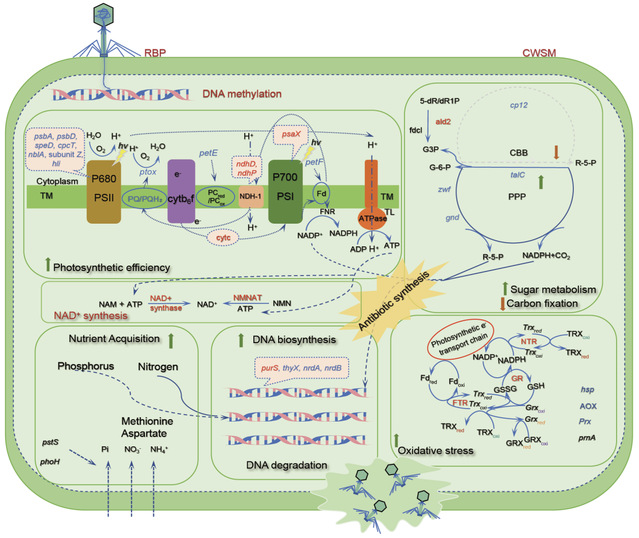
Results In this study, we report a novel marine T4-like cyanophage, S-SCSM2R, that is able to cross-infect eight picocyanobacterial phylogenetic clades, including three Prochlorococcus clades of both high-light and low-light ecotypes and eight Synechococcus subclades across all five Synechococcus clades of 5.1, 5.2, 5.3, Subalpine II and Bornholm Sea. S-SCSM2R contains novel auxiliary metabolic genes involved in photosynthesis, alleviation of oxidative stress, cell wall synthesis and modification, and antibiotic synthesis. Alongside the receptor-binding protein gene, a set of counterdefense genes related to DNA methylation and NAD+ synthesis provide clues about the broad cross-infectivity of S-SCSM2R.
Conclusions S-SCSM2R has an extremely broad host range and novel genetic features related to phage–host interactions. The discovery and characterization of S-SCSM2R broaden our knowledge of cyanophage cross-infectivity and reveal new ways in which cyanophages manipulate host metabolism in marine ecosystems.
Full article: https://doi.org/10.1186/s12915-025-02481-8