
Chen Li1, Haowen Dang1, Jinlong Du1, Hongliang Li2, Jingjing Zhang2, Zhimin Jian1
1State Key Laboratory of Marine Geology, Tongji University, Shanghai, China,
2Key Laboratory of Marine Ecosystem Dynamics, Second Institute of Oceanography, Ministry of Natural Resources, Hangzhou, China
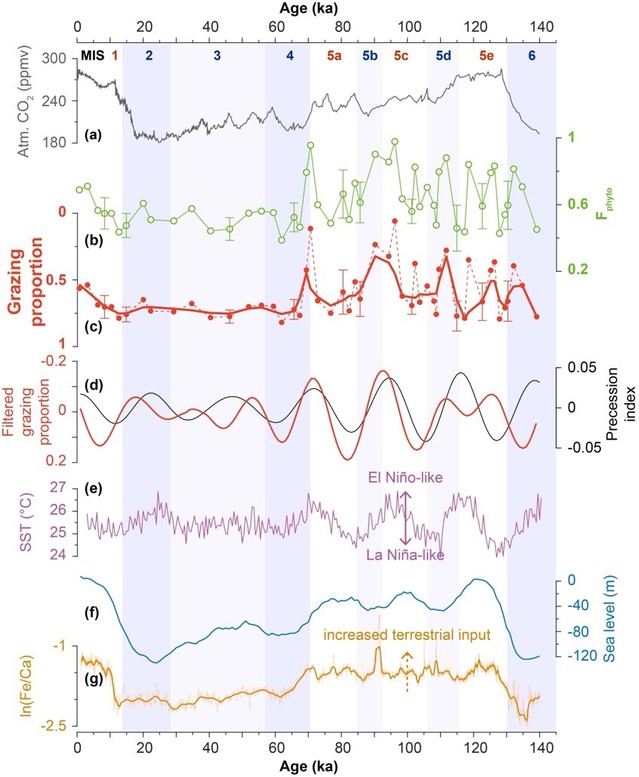
Abstract:The carbon sequestration capacity of the biological carbon pump (BCP) is determined by surface ocean carbon fixation and the transportation of fixed carbon to the ocean interior, which is closely linked to the trophic structure of planktonic ecosystem. However, previous biogeochemical reconstructions focused mostly on primary productivity, overlooking changes in community structure (e.g., ratio of primary producers to consumers). In this study, we investigate the late Quaternary history of planktonic trophic structure in the western equatorial Pacific by generating sedimentary amino acid δ15N record of Site MD10-3340. Our results demonstrate well-preserved amino acid δ15N signatures. Using the δ15N gradients between trophic and source amino acids, we calculate the average sedimentary trophic position and design an idealized ecosystem model to quasi-quantitively estimate changes in grazing proportion (the proportion of primary production consumed by zooplanktons). Notably, lower trophic position and smaller grazing proportion point to a decline of zooplankton grazing during precession maxima, which is primarily attributed to enhanced nutrient availability in the western equatorial Pacific during El Niño-like mean-states. Moreover, average grazing proportion is slightly lower during Interglacial warmth than the last glacial period, implying a secondary control of sea level change. Furthermore, our ocean-biogeochemical simulations show that a halved grazing proportion could cause pronounced decrease in Pacific carbon storage and a remarkable increase in atmospheric pCO2, due to a shallower remineralization depth. We thus highlight the necessity to incorporate varying marine grazing proportions into future proxy reconstructions and model simulations to facilitate a more comprehensive understanding of the BCP.
Full Article:https://doi.org/10.1029/2025AV002024