
Fenghao Liu1 ,Enqing Huang1, Jinlong Du1, Wentao Ma2, Zhonghui Liu3,Lucas J. Lourens4, Jun Tian1
1State Key Laboratory of Marine Geology, Tongji University, Shanghai, China.
2State Key Laboratory of Satellite Ocean Environment Dynamics, Second Institute of Oceanography, Ministry of Natural Resources, Hangzhou, China.
3Department of Earth Sciences, The University of Hong Kong, Hong Kong, China.
4Department of Earth Sciences, Faculty of Geosciences, Utrecht University, Utrecht, 4Netherlands.
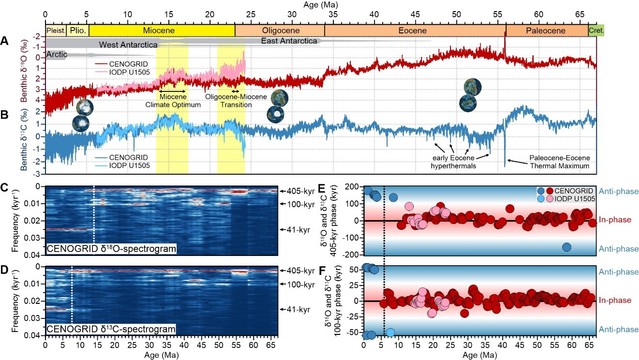
Abstract: During the Cenozoic unipolar ice ages, benthic foraminiferal oxygen and carbon isotopes (proxies for bottom-water temperature and ice volume and for the carbon cycle, respectively) exhibited in-phase changes on eccentricity timescales. However, the mechanisms underlying this synchronized relationship remain unclear. Here, we present a high-resolution reconstruction of Miocene benthic foraminiferal boron-to-calcium ratios, revealing that eccentricity-paced fluctuations in deep-sea carbonate ion saturation covaried with oxygen and carbon isotopes, as well as with pelagic carbonate deposition. Integrating model results, we propose that orbital configurations and elevated temperatures during eccentricity maxima intensified monsoon rainfall and chemical weathering, enhancing the transport of dissolved inorganic carbon and alkalinity from land to sea. These processes further redistributed massive carbonate burial from deep-ocean basins to continental shelves, lowering carbonate ion concentration and the carbon isotopic composition of seawater. Our findings underscore the crucial role of the low-latitude hydrological cycle in regulating carbon-cycle dynamics under warm climatic conditions.
Full Article:https://www.science.org/doi/10.1126/sciadv.adx6682