
Yuanqing Chen a b, Christian März b, Zijun Wu a, Nicole Kowalski c 1, Wenli Xia a, Alexander Stark c 2, Michael Ernst Böttcher c d e
a State Key Laboratory of Marine Geology, Tongji University, Shanghai 200092, China
b Institute for Geosciences, University of Bonn, D-53115 Bonn, Germany
c Geochemistry & Isotope Biogeochemistry Group, Department of Marine Geosciences, Leibniz Institute for Baltic Sea Research (IOW), D-18119 Warnemünde, Germany
d Marine Geochemistry, University of Greifswald, D-17489 Greifswald, Germany
e Interdisciplinary Faculty, University of Rostock, D-18059 Rostock, Germany
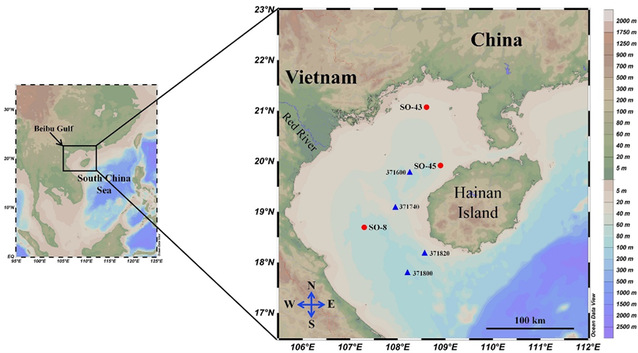
Abstract: Iron-bound phosphorus (Fe-P) represents a substantial sink for phosphorus (P) in marine sediments, yet its formation is commonly attributed to iron reduction coupled to anaerobic oxidation of methane (Fe-AOM). However, the processes governing Fe-P formation below the Marine-Terrestrial Transition (MTT), the stratigraphic interface separating Holocene marine sediments from underlying terrestrial deposits, remain poorly constrained in sediments lacking Fe-AOM activity. To address this knowledge gap, we investigated seven sediment cores from the Beibu Gulf (South China Sea), a subtropical shelf system that sequestered extensive terrigenous iron (oxyhydr)oxide (FeOx) within terrestrial layers during the last glacial lowstand. By integrating porewater geochemistry (Cl−, SO42−, Ca2+, DIC, δ13C-DIC, NH4+, Fe2+, Mn2+ and PO43−), solid-phase speciation (C, S, Fe, P), and μXRF analysis, we elucidate diagenetic controls on P cycling across the MTT. Below the MTT depth, C/N ratios and δ13C values indicate that sedimentary organic matter is primarily of terrigenous origin. Downward-diffusing sulfide diffuses from overlying Holocene marine mud reacts with reactive FeOx in the underlying limnic sediments, driving pyrite accumulation. Although sulfide-induced FeOx dissolution releases Fe2+ and PO43− into porewater, the cumulative sulfide supply over the Holocene has been insufficient to exhaust the vast pre-transgression inventory of FeOx, resulting in substantial Fe-P retention below the MTT. While porewater Fe2+ and PO43− co-accumulation suggests potential Fe(II)-phosphate formation, sequential extraction and mineralogical analyses did not identify these phases, likely due to the sediments' position above the Sulfate-Methane Transition. We propose a diagenetic pattern for Fe-S-P evolution since the last glacial maximum that is applicable to continental shelves and marginal seas globally that experienced post-glacial marine transgression. Our findings reveal that Fe-P constitutes a larger fraction of the total P pool below the MTT than previously recognized, implying its burial may be substantially underestimated in global budgets. Given the lability of Fe-P and complexity of coastal systems during sea-level lowstands, quantitative constraints on global FeP burial fluxes are essential for refining marine biogeochemical models.
Full Article:https://doi.org/10.1016/j.chemgeo.2026.123334