
Zhifei Duan a, Chao Li a, Helen Bostock b, Yanguang Liu c, Jian-xin Zhao b, Yiming Luo d, Yonghua Wu c, Ai Nguyen b, Shouye Yang a
a State Key Laboratory of Marine Geology, Tongji University, Shanghai, 200092, China
b School of the Environment, The University of Queensland, Brisbane, QLD 4072, Australia
c Key Laboratory of Marine Geology and Metallogeny, First Institute of Oceanography, Ministry of Natural Resources, Qingdao, 266061, China
d School of Marine Sciences, Sun Yat-Sen University, and Southern Marine Science and Engineering Guangdong Laboratory (Zhuhai), Zhuhai, 519082, China
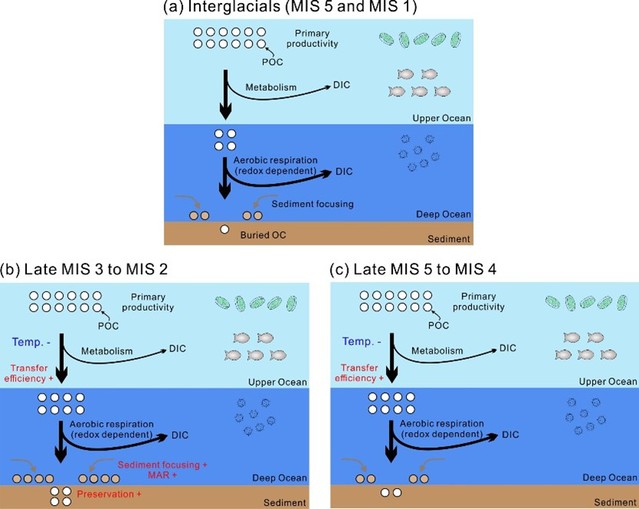
Abstract: Glacial-interglacial cycles are marked by large fluctuations in atmospheric CO2, with the oceanic biological pump playing a critical role in regulating these changes. The South China Sea (SCS), a low-latitude marginal sea characterized by oligotrophic conditions and high sedimentation rates, provides a unique setting to investigate past variations in the biological pump on continental margins. In this study, we present the first record of 230Th-normalized biogenic fluxes (total organic carbon, opal, CaCO3) in the SCS over the past 120 kyr. We examine the potential controlling factors of organic carbon burial to infer the evolution of the biological pump over this period. The record reveals that sediment focusing was persistent, but varied, highlighting the need to correct for lateral transport. Total organic carbon (TOC) flux increased across the marine isotope stage (MIS) 5a–4 transition, potentially reflecting enhanced surface-to-deep transfer efficiency, which may be linked to cooler ocean conditions and associated changes in remineralization dynamics. Between late MIS 3 and MIS 2, TOC flux peaked, likely reflecting both increased transfer efficiency and enhanced preservation under high sedimentation rates. These changes are consistent with a strengthened biological pump in glacial periods that may have facilitated CO2 drawdown. Moreover, reduced CaCO3 fluxes indicate a weakened carbonate pump during the MIS 4 and MIS 2, further reinforcing CO2 sequestration. The temporal alignment between elevated TOC fluxes and major phases of atmospheric CO2 decline suggests the potential role of the biological pump on continental margins in amplifying glacial CO2 drawdown. These findings provide a framework for integrating continental margin processes into global carbon cycle reconstructions.
Full Article:https://doi.org/10.1016/j.epsl.2026.119976