
Simon V. Hohl a, Sebastian Viehmann b, Philipp Gleissner c, Ashley N. Martin d& Martin J. Van Kranendonk e
a State Key Laboratory of Marine Geology, Tongji University Shanghai, Shanghai, PR China
b Institute of Earth System Sciences, Section Mineralogy, Leibniz University Hannover, Hannover, Germany
c Department of Earth Sciences, Freie Universität Berlin, Berlin, Germany
d Department of Geography and Natural Sciences, Northumbria University, Newcastle, UK
e School of Earth and Planetary Sciences, Curtin University, Perth, WA, Australia
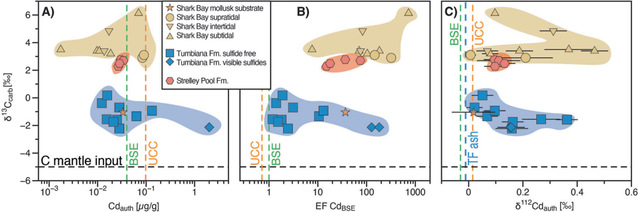
Abstract:Stromatolites record interactions of the biosphere, atmosphere, and hydrosphere. The evolution of C-fixation via diverse metabolisms is linked to metal availability for enzymes such as carbonic anhydrase. Stable Cd isotopes fractionation during uptake into carbonic anhydrase by modern phototrophs is readily recorded in authigenic carbonates. Here we test whether this proxy can be expanded to trace carbonic anhydrase in the microbial rock record. We analyzed Cd isotopic compositions in stromatolite occurrences of Western Australia, spanning from the Archean ( ~ 3.35 Ga Strelley Pool and ~2.72 Ga Tumbiana formations) to the Holocene Hamelin Pool. We record fractionated Cd isotopic compositions correlating with macro and micro-nutrients P, Cd and Zn, suggesting enzymatic metal-cycling in the Paleoarchean. Meanwhile, Rayleigh-type Cd isotope fractionation indicates its use as a co-factor in carbonic anhydrase from the Meso- to Neoarchean onwards. Our study offers new insights into the evolution of the metallome and its role facilitating early microbial metabolisms.
Full Article:https://doi.org/10.1038/s43247-026-03291-8