

Ce Yang1, Haowen Dang2, Jian Xu1, Xiaolin Ma3, Xingxing Wang2, Yu Ren2, Hongrui Zhang2, Chen Li2, Peng Zhang1, Haijing Chen2, Franck Bassinot4, Yair Rosenthal5,6 & Zhimin Jian2
1. State Key Laboratory of Continental Evolution and Early Life, Department of Geology, Northwest University, Xi’an, China
2. State Key Laboratory of Marine Geology, Tongji University, Shanghai, China
3. State Key Laboratory of Loess Science, Institute of Earth Environment, Chinese Academy of Sciences, Xi’an, China
4. Laboratoire des Sciences du Climat et de l’Environnement/IPSL, CEA-CNRS-UVSQ, Université Paris-Saclay, Gif-sur-Yvette, France
5. Department of Marine and Coastal Science, Rutgers University, New Brunswick, NJ, USA
6. Department of Earth and Planetary Sciences, Rutgers University, New Brunswick, NJ, USA
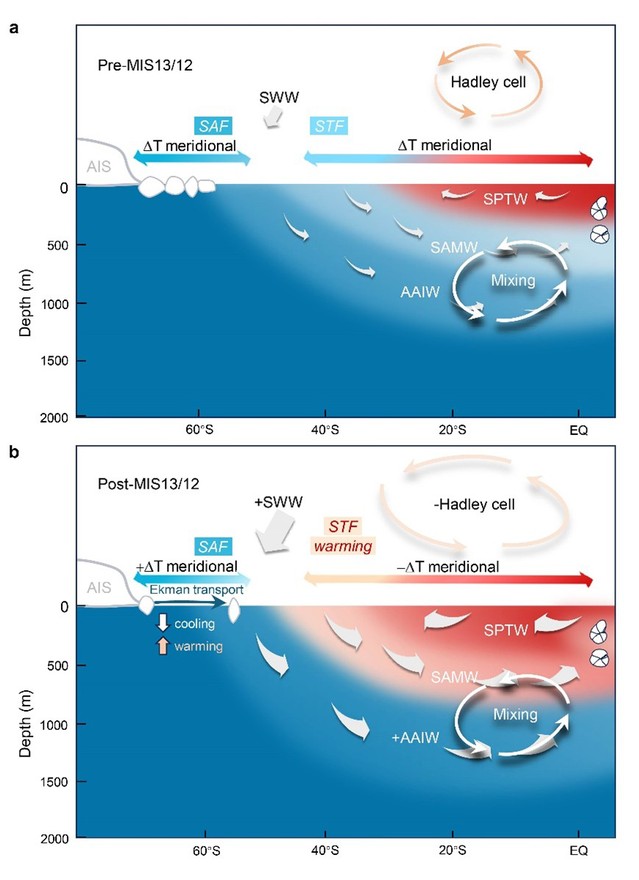
Abstract: The Mid-Brunhes Transition (MBT) signifies a pivotal shift in glacial–interglacial cycles with intensified interglacial warming, yet its underlying mechanisms remain elusive. Targeting the most sensitive component of oceanic heat uptake, the southern-sourced sub-surface waters, the post-MBT ocean heat dynamics are investigated using reconstructed deep and bottom thermocline temperatures from the Western Equatorial Pacific. Our results show that, since the MBT, the deep thermocline temperature has been gradually declining in association with cooling within the (sub)tropical Pacific upper ocean circulation. In contrast, the bottom thermocline temperature shows a pronounced rising trend independent of the calibration-derived uncertainties in its absolute estimates. Such post-MBT bottom thermocline warming is consistent with an enhanced advection of southern-sourced subsurface waters, as indicated by strengthened Southern Ocean meridional thermal gradients and concurrent warming in the southern subtropics. It is thus suggested that enhanced equatorward transport of southern-sourced subsurface waters, as a cross-hemispheric heat-redistribution pathway, may have elevated the background thermal state of post-MBT interglacials, highlighting the potential role of tropical-Southern Ocean connection in shaping climate trajectories.
Full article: https://doi.org/10.1038/s41467-026-71829-7