
Xue Han a, Yulong Guo a, Qiang Hao b, Xiaobao Gao a, Shijun Wang a, Jinniu Chen a, Bo Yang a, Shouye Yang a
a. State Key Laboratory of Marine Geology, Tongji University, Shanghai, 200092, China
b. The Engineering & Technical College of Chengdu University of Technology, Leshan, 614000, China
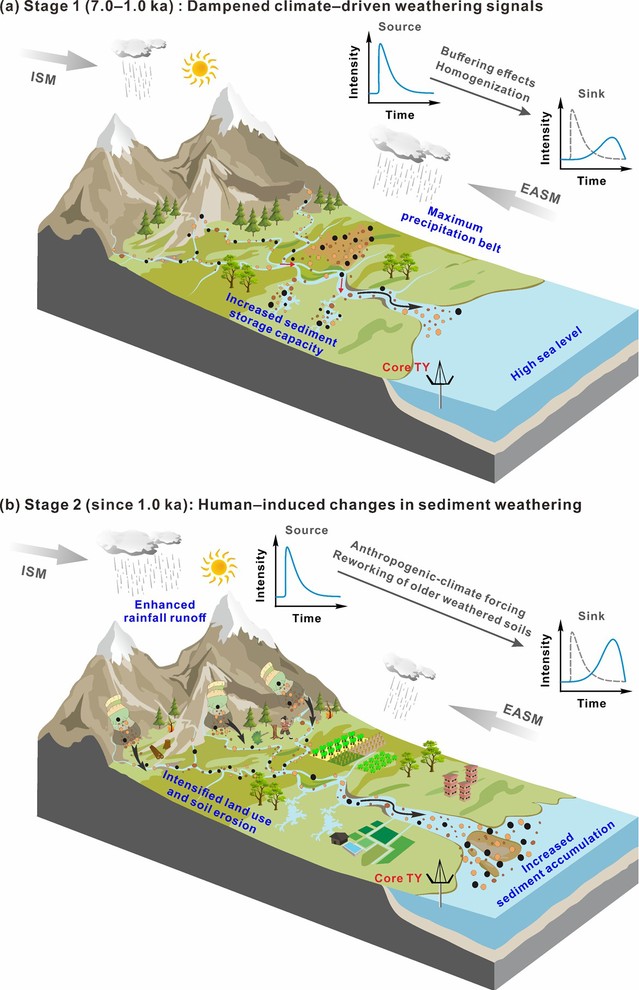
Abstract: Silicate weathering plays a fundamental role in regulating Earth's climate and carbon cycle. Despite numerous studies on silicate weathering in large river basins, its response to millennial-scale climate variability and anthropogenic activities remains poorly constrained, largely due to prolonged sediment residence times and complex source-to-sink processes within large catchments. Here, we present high-resolution Holocene records of geochemical and mineralogical compositions from Core TY sediments in the Changjiang (Yangtze River) Delta, aiming to reconstruct temporal variations in silicate weathering over the past 7.0 kyr. By integrating other borehole data and paleoclimate archives, we identify two stages of weathering evolution in the Changjiang Basin during the mid- to late Holocene. In Stage 1 (7.0–1.0 ka), the core sediments were moderately weathered with relatively stable compositions, primarily attributed to steady sediment supply from the mid-lower basin. The weathering proxies did not respond promptly to the weakening Asian Summer Monsoon after the Holocene Climatic Optimum, likely due to the weak climate–weathering dependency and strong buffering of weathering signals within the large alluvial plains. Stage 2 (since 1.0 ka) recorded a marked enhancement in weathering proxies of deltaic sediments, accompanied by increasing sediment contributions from the upper basin. This shift coincides with strengthened monsoon rainfall and intensified human activities upstream. We infer that large-scale population migrations have accelerated deforestation and land reclamation in Southwest China, likely promoting the erosion and remobilization of older weathered soils transported to the delta. Overall, our findings indicate that on millennial timescales, both climatic and anthropogenic forcings jointly modified sediment source-to-sink pathways in the Changjiang Basin, thereby modulating the transmission and preservation of weathering signals in deltaic sediments. This study provides new insights into the complex interplay among chemical weathering, climate change, and human activities in the large river systems worldwide.
Full article:https://doi.org/10.1016/j.quascirev.2026.109920