
Kai Deng1,2,*, Hella Wittmann2, Shouye Yang1, James T. Liu3, and Friedhelm von Blanckenburg2,4
1. State Key Laboratory of Marine Geology, Tongji University, 200092 Shanghai, China
2. GFZ Helmholtz Centre for Geosciences, Organic and Earth Surface Geochemistry, Telegrafenberg, 14473 Potsdam, Germany
3. Department of Oceanography, National Sun Yat-sen University, Kaohsiung 80424, Taiwan
4. Institute of Geological Sciences, Freie Universität Berlin, 12249 Berlin, Germany
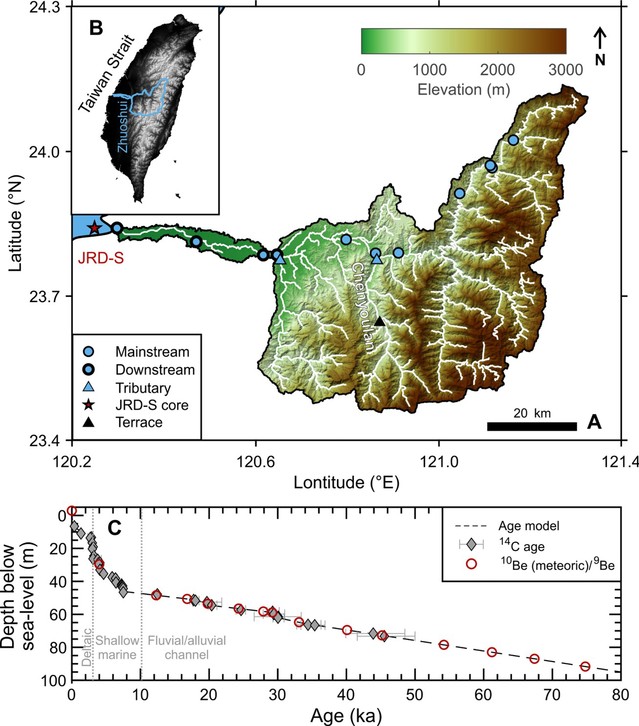
Abstract: The impact of climate on continental denudation is most pronounced in high mountain ranges, which generate a disproportionally large amount of sediment for their area. However, there are currently limited tools to accurately reconstruct past denudation. We present a record of basin-scale paleo-denudation rates since the last glacial period in the low-latitude, rapidly eroding Taiwan orogen. We measured 10Be(meteoric)/9Be ratios in dated coastal sediments and converted them into paleo-denudation rates. Our results reveal large variations in denudation rates (0.1−3.0 mm/yr). These variations do not mirror large-scale climate trends recorded by marine benthic δ18O. Instead, denudation rates are primarily influenced by the intensity of the East Asian monsoon. This observation is complementary to previous paleo-10Be studies in mid-latitude regions, where basin-scale denudation is mainly driven by glacial or periglacial processes. Climatic cycles appear to exert a primary control over denudation, where the relative importance of specific climatic factors likely varies across latitudinal zones.
Full article: https://doi.org/10.1130/G54095.1