
Liping Tian a, b, Jinyong Yu a, Li Li a, *, Yanming Ruan a, c, Jiantao Cao a, Xinkang Zhang a, Juan He a, Mengyuan, Wang b, *, Jennifer B. Wurtzel d, Guodong Jia a
a State Key Laboratory of Marine Geology, Tongji University, Shanghai, 200092, China
bSchool of Marine Sciences, Sun Yat-sen University, Zhuhai, 519082, China
c MARUM–Center for Marine Environmental Sciences, University of Bremen, Bremen, 28359, Germany
d New South Wales Department of Primary Industries and Regional Development, Orange Agricultural Institute, Orange, NSW 2800, Australia
Abstract
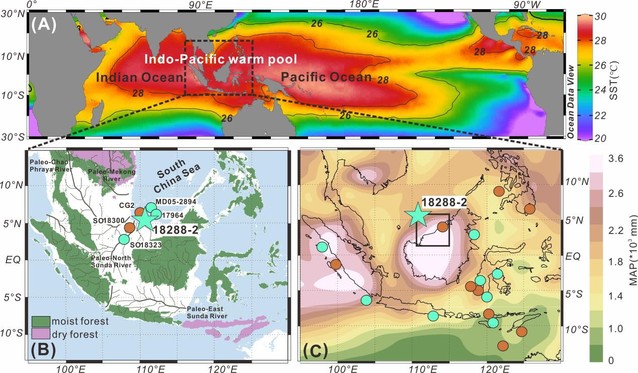
Changes in the glacial-interglacial climate forcings, especially due to landmass configuration, complicate vegetation and hydroclimate reconstructions over the Indo-Pacific warm pool (IPWP). Here, we present vegetation and hydroclimate records since 18.3 ka from the southern South China Sea (SCS) using leaf wax δ2H and δ13C proxies. Comparisons between the δ13C of long-chain n-alkanes and n-alcohols show that there was little change in either local or distal vegetation ecosystems over the northeastern Sunda Shelf, which were dominated by rainforest throughout the last-deglacial period. Our study highlights the necessity of vegetation correction for interpreting the δ2H of n-alkanes as the δ2H of mean annual precipitation (δ2HMAP), by evaluating the n-alkanes chain length distributions and carbon isotopes simultaneously. The reconstructed δ2HMAP supports the results of the isotope-enabled Transient Climate Evolution (iTRACE) model in recording last-deglacial precipitation amount changes on millennial scales, showing a drier HS1, wetter BA, and drier YD. However, we found that the reduced shelf exposure area from 12.1 to 11.0 cal ka BP due to inundation of the Sunda Shelf contributed to the δ2HMAP becoming disconnected from the precipitation amount. Moreover, intense evaporation over the exposed Sunda Shelf during the last deglaciation probably caused the intercept of the paleo-atmospheric precipitation line (δ2H = 7.1 × δ18O – 17.2) to be lower than the modern.
Full article:https://doi.org/10.1016/j.catena.2026.110241