
Yuanqing Chen1,2 , Christian März2, Zhe Zhou1, Shouye Yang1 , and Zijun Wu1
1State Key Laboratory of Marine Geology, Tongji University, Shanghai, China,
2Institute for Geosciences, University of Bonn, Bonn, Germany
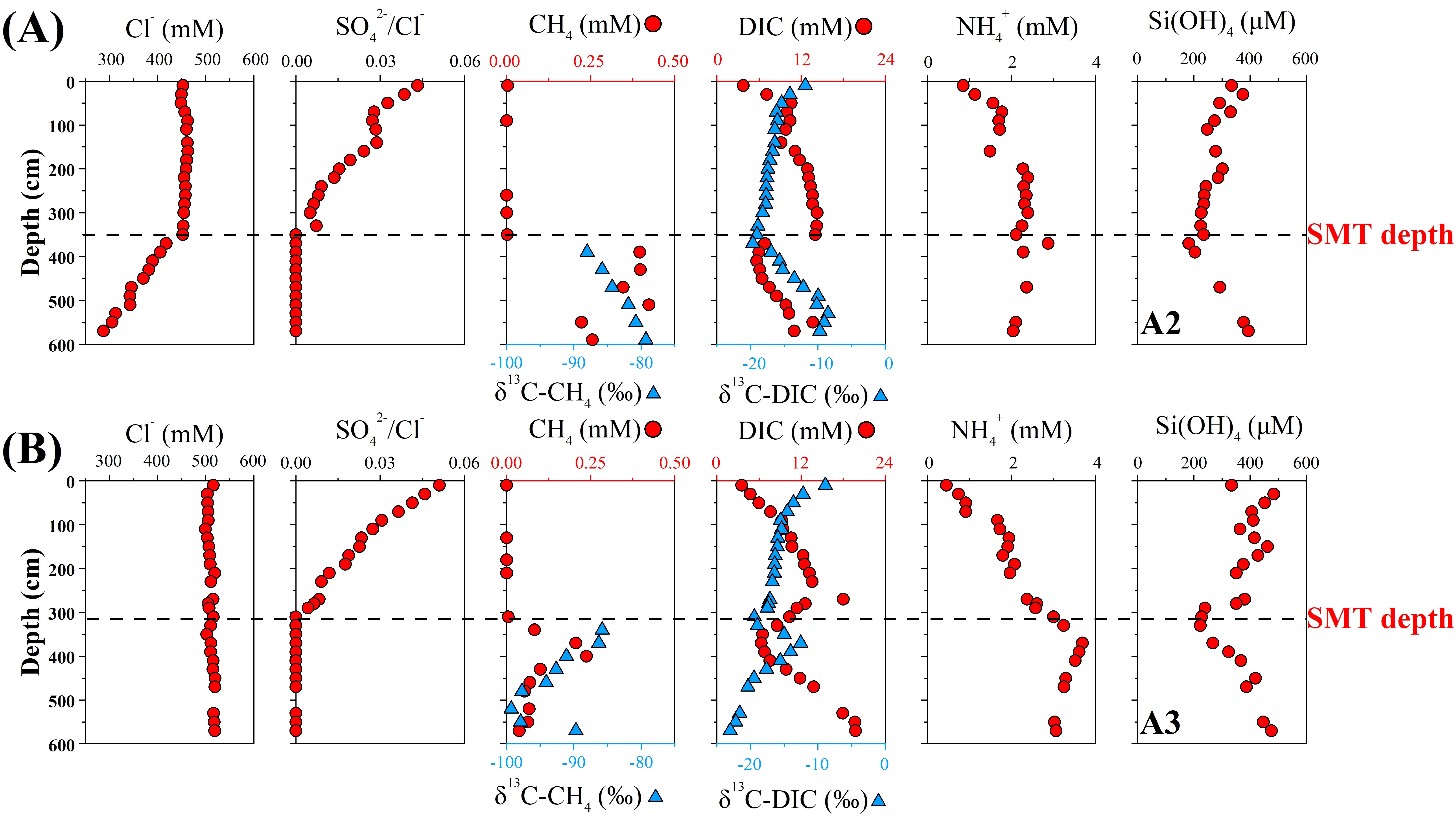
Abstract:Porewater dissolved inorganic carbon (DIC) cycling plays a central role in marine carbon budgets, yet its regulation by forward and reverse weathering remains poorly constrained on large-river-dominated continental shelves. To address this gap, we integrated porewater geochemistry, isotopic signatures, and solid-phase profiles from two contrasting environments in the Yangtze estuary mud belt: site A2, characterized by shallow-gas-induced paleo-freshwater intrusion, and site A3, representing a stable inner-shelf setting. At both sites, reverse weathering and authigenic carbonate formation collectively govern alkalinity dynamics above the sulfate-methane transition (SMT). Quantitative calculations indicate that reverse weathering serves as a significant alkalinity sink in shallow sediments, consuming 18–21 mmol m−2 yr−1, which accounts for 11%–16% of the total alkalinity (TA) budget. The conversion of bicarbonate alkalinity (HCO3−) to CO2 subsequently lowers the TA/DIC ratio of the porewater effluxes by a similar proportion, complicating coastal carbon budgets. Below the SMT, the two sites exhibit contrasting diagenetic regimes. At site A2, high alkalinity derived from anaerobic oxidation of methane promotes intense authigenic precipitation, thereby counteracting forward weathering release. In contrast, at site A3, methanogenesis-derived acidity inhibits authigenic clay and carbonate formation, enabling NH4+-driven cation exchange and forward weathering. Furthermore, at site A3, our analysis reveals forward weathering as a critical DIC-neutral alkalinity source that simultaneously consumes CO2 and generates alkalinity. Our findings demonstrate that both forward and reverse weathering is critical regulators of porewater carbon and alkalinity. This work also provides an improved framework to more accurately constrain carbon budgets and inform acidification projections in the world's river-dominated margins.
Full Article:https://doi.org/10.1029/2025JC023802