
Wei Yuan a,* , Zhenyu Yang b , Yang Zhang c , Huaiyang Zhou d , Zilian Fan a , Lingmin Zhang a , Jia Sun a
a State Key Laboratory of Marine Geology, Tongji University, Shanghai, 200092, China b College of Resources, Environment and Tourism, Capital Normal University, Beijing, 100048, China
c Faculty of Geosciences, University of Bremen, Bremen, 28359, Germany
d Department of Ocean Science and Engineering, Southern University of Science and Technology, Shenzhen, 518055, China
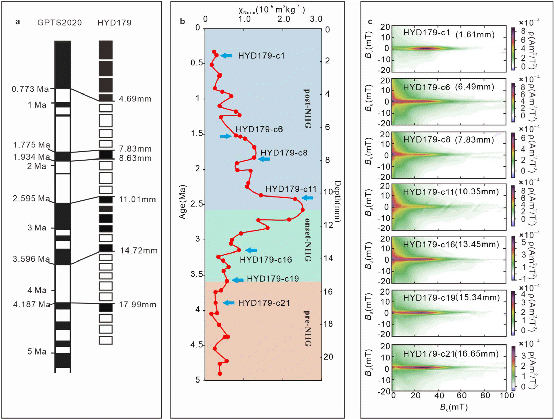
Abstract:Magnetic minerals serve a dual role in Earth sciences, acting as key tracers in the global iron cycle and fundamental recorders of sedimentary paleomagnetic signals. However, in marine settings, such signals are often compromised by diagenetic alteration. Hydrogenetic ferromanganese (Fe-Mn) crusts, which grow on sediment-free seamounts throughout the global ocean, provide a unique archive that avoids post-depositional overprinting. Here we present high-resolution rock magnetic data from a 4.9 Ma Fe-Mn crust recovered from a seamount in the South China Sea. Our results reveal three distinct phases of magnetic mineral assemblage evolution. From 4.9 to 3.6 Ma, biogenic magnetite dominated, corresponding to low magnetic susceptibility. Between 3.6 and 2.6 Ma, magnetic susceptibility and magnetic grain size increased substantially, reflecting a rising contribution of terrigenous detrital multidomain (MD) magnetite alongside the biogenic component. After 2.6 Ma, both susceptibility and grain size declined as MD magnetite content decreased. We attribute the enhanced MD magnetite flux during 3.6–2.6 Ma to intensified physical weathering of continental source rocks, triggered by strengthened East Asian Summer Monsoon precipitation following the onset of Northern Hemisphere glaciation (NHG). This monsoon-driven erosion likely increased fluvial supply of bioavailable Fe(II)-bearing magnetite to the ocean, potentially stimulating phytoplankton productivity and contributing to atmospheric CO2 drawdown and global cooling.
Full Article:https://doi.org/10.1016/j.quascirev.2026.110117