
Youqiang Yu a b, Jiaji Xi a, Alexander Koptev c d, Taras Gerya e, Frederik Tilmann b f, Karyono Karyono g, Xun Yu a, Muchen Sun h, Giridas Maiti i, Nevena Andri-Tomaševi i
aState Key Laboratory of Marine Geology, Tongji University, Shanghai, 200092, China
bGFZ Helmholtz Centre for Geosciences, Potsdam, 14473, Germany
cSchool of Earth Sciences and Engineering, Nanjing University, Nanjing, 210023, China
dHUN-REN Institute of Earth Physics and Space Science, Sopron, 9400, Hungary
eInstitute of Geophysics, Department of Earth Sciences, Swiss Federal Institute of Technology (ETH Zürich), Zürich, 8092, Switzerland
fInstitute for Geological Sciences, Freie Universität Berlin, Berlin, 12249, Germany
gIndonesian Agency for Meteorology, Climatology, and Geophysics (BMKG), Jakarta, 10720, Indonesia
hDepartment of Geological Engineering, Montana Technological University, Butte, Montana, 59701, USA
iInstitute of Applied Geosciences, Karlsruhe Institute of Technology, Karlsruhe, 76131, Germany
Abstract
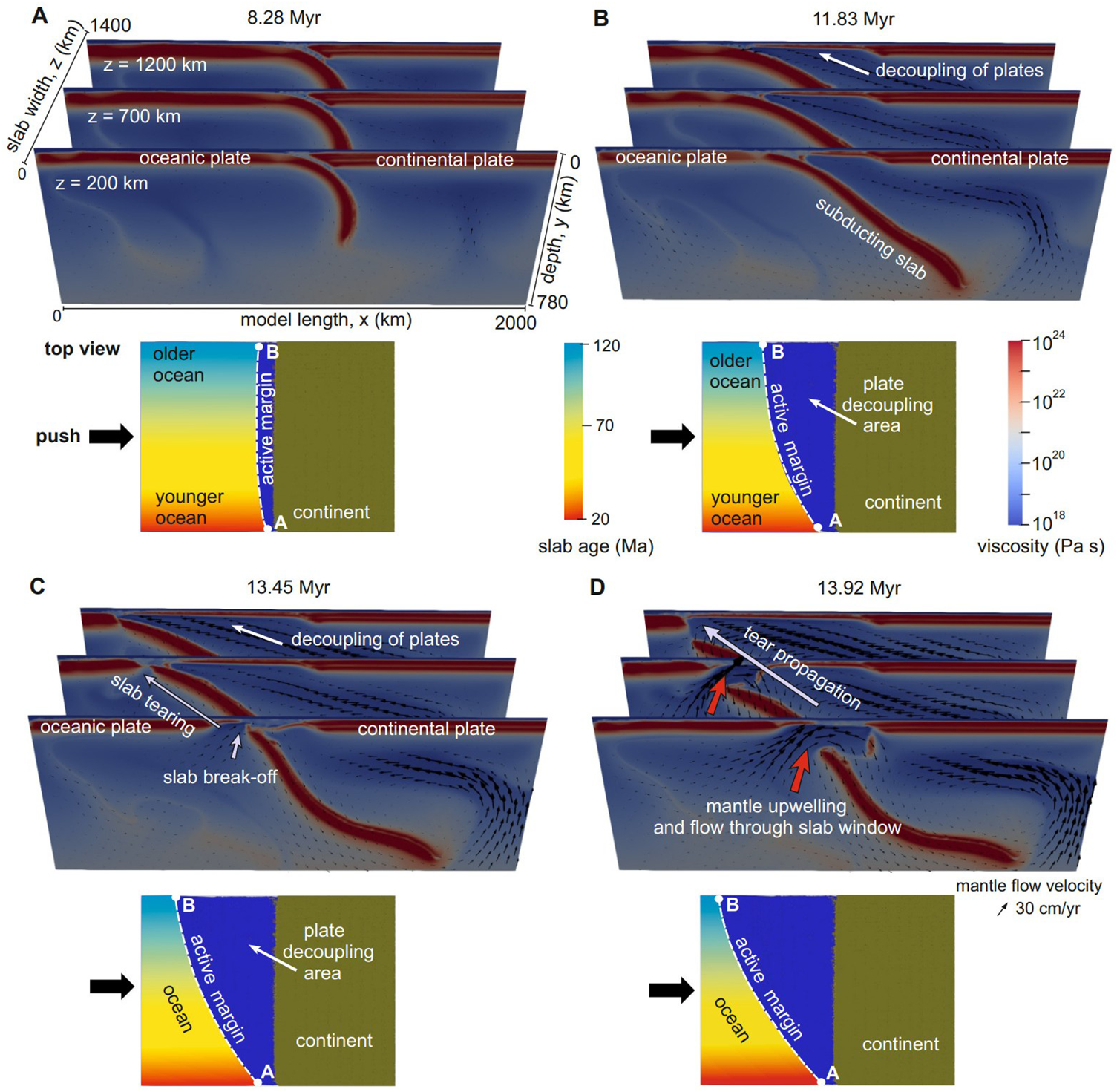
Subducting slabs generally inhibit mantle exchange between ocean basins and marginal seas, yet the origin of Indian Ocean MORB-type mantle signatures in the southwestern South China Sea remains debated. Here, we image mantle transition zone (MTZ) structure beneath Sumatra using receiver functions that account for non-planar wavefronts. Stacking 34,255 records from 197 stations reveals widespread MTZ thickening beneath central and southern Sumatra, accompanied by pronounced along-strike heterogeneity. In central Sumatra, MTZ thickening in the middle segment is primarily associated with a depressed 660-km discontinuity, whereas adjacent segments are characterized by predominant uplift of the 410-km discontinuity (d410), indicating a laterally discontinuous slab. This inference is further supported by a gap in slab-related velocity anomalies near d410, localized MTZ thinning in the forearc, and contrasting discontinuity signatures, including a sharp d410 and weak 520-km phases in the middle segment versus stronger or locally split 520-km signals and broadened d410 phases in adjacent segments. These observations favor the presence of a slab window beneath central Sumatra, likely representing a fossil slab breakoff event initiated during the late Early to Middle Miocene (∼20–15 Ma). Numerical modeling further suggests that along-trench slab age variations can trigger such non-collisional slab breakoff, facilitating mantle material exchange between the Indian Ocean and the South China Sea.
Full Article:https://doi.org/10.1016/j.epsl.2026.120306